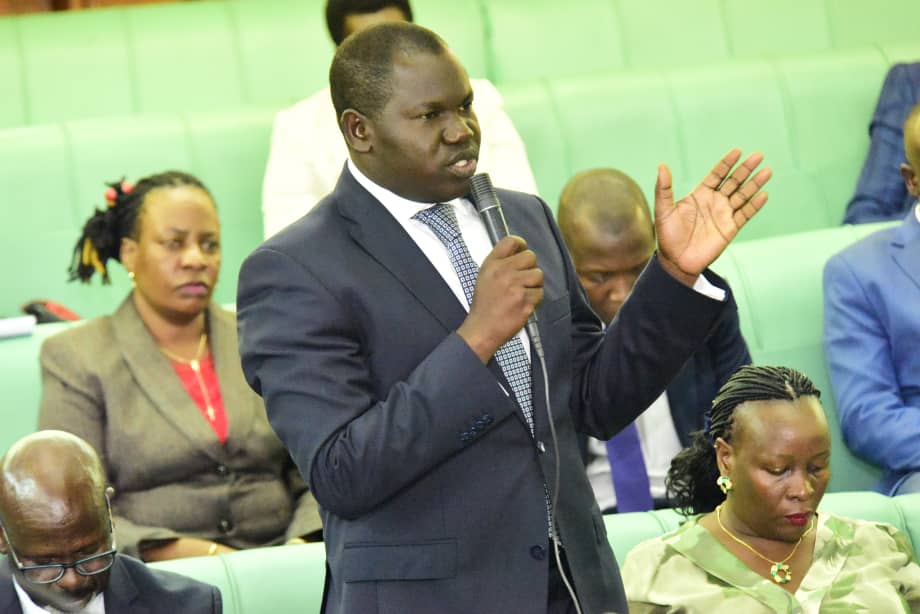
Soroti City West Member of Parliament, Hon. Jonathan Ebwalu, has retariated his calls over what he describes as an opaque and unfair system through which the Ugandan government extends massive bailouts to wealthy private companies at the expense of ordinary taxpayers.
Speaking passionately recently during a plenary session on Thursday, Ebwalu urged the Speaker of Parliament, Rt. Hon. Anita Annet Among, to compel the Ministry of Finance to produce a comprehensive list of all investors and companies that have received bailouts, grants, or loans from public funds.
In his address, Ebwalu decried what he termed as a betrayal of the hardworking citizens whose taxes are being used to enrich already wealthy individuals and corporations.

“This country collects a lot of money. We would survive even without donor funding or loans. But Madam Speaker, what pains me is that the poor people collect this money and then we go and give it to rich companies in the name of bailouts,” he said.
Citing specific cases, the legislator referenced government bailouts of Shs 200 billion each to Roofings Limited, ROKO Construction, and Simba Group.
He also alluded to a Shs 26 billion allocation to an unnamed investor and financial support to a private pharmacy in Ntungamo, all funded through taxpayer money.
“We collected money from the poor in Kikubo, Soroti, and Kagadi, and used it to bail out big corporations. Meanwhile, the people in these same areas continue to suffer, and when they need help, ministers do not respond,” he lamented.
Ebwalu questioned the criteria used by the Ministry of Finance to select beneficiaries of the bailouts, noting that many deserving Ugandans and struggling small businesses continue to suffer without support.
“What criteria does the Ministry of Finance or government use to bail out particular companies in Uganda? Yet the poor people are suffering,” he asked.
The MP emphasized that his concern is not with the concept of government bailouts, but rather the lack of transparency, equity, and accountability in how these financial decisions are made.
He called on Parliament to take action by demanding a full disclosure of all companies and individuals who have benefited from government funds in the form of loans or grants.
“Some of these investors have not paid back the money. This is government money, taxpayers’ money. We are simply asking for transparency and a clear criterion that is fair to all Ugandans,” Ebwalu stressed.
He also linked the issue of selective bailouts to broader concerns about the marginalization of Ugandan professionals in key sectors.
In particular, he criticized the continued awarding of multimillion-dollar infrastructure contracts to foreign companies, while local engineers and firms remain sidelined.
“We are talking about empowering local people, yet our roads are being constructed by Chinese and Arab companies. Meanwhile, Makerere University is producing competent engineers. Why aren’t they being trusted with these contracts?” he questioned.
Ebwalu’s remarks triggered murmurs of agreement across the parliamentary chamber, with several MPs nodding in support of the call for financial transparency.
In April 2024, Uganda’s Speaker Anita Annet Among had said that, “I don’t mind local people being bailed out but we only need to define the criteria of who should be bailed out and the impact to the country.”
The debate comes at a time when the government is facing growing criticism over its fiscal priorities, particularly amid rising public debt and deteriorating public services.
Civil society groups and economists have increasingly questioned the logic of allocating billions of shillings to private companies while critical sectors such as health, education, and agriculture remain underfunded.
About Author