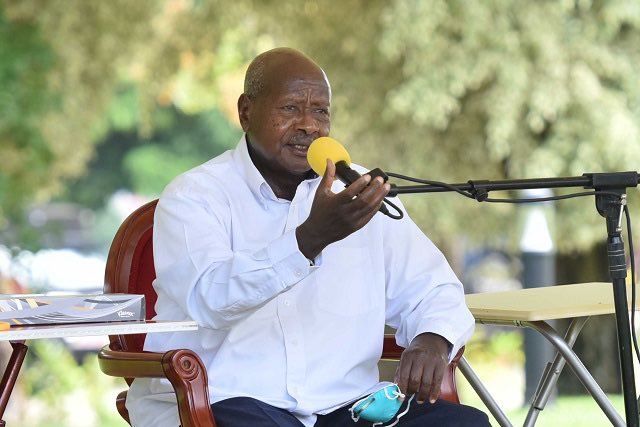
President Yoweri Kaguta Museveni has confirmed that Members of Parliament (MPs) recently received Shs100 million each, a revelation that has stirred a political storm across the country.
In a four-page statement released on Friday, Museveni defended the disbursement and instead turned the spotlight on opposition politicians, accusing them of hypocrisy and dodging bigger questions about foreign interference in Uganda’s politics.
“I saw a cluster of Opposition MPs, led by a one Kivumbi, spending a lot of energy on the supposed Shs100 million per person given to MPs through classified funds,” Museveni wrote. “In this campaign, these Opposition MPs are supported by the anti-Ugandan newspaper known as Monitor.”

The cash bonanza, drawn from the recently passed Shs4 trillion supplementary budget, has triggered widespread backlash, with civil society groups and opposition leaders accusing the government of wasteful spending amidst economic hardships faced by ordinary Ugandans.
But Museveni was unapologetic.
He argued that while the NRA/UPDF soldiers sacrificed for years without pay, today’s leaders require motivation through various forms of facilitation, some of which, he admitted, are funded through classified budgets.
“We, the FRONASA-NRA combatants, fought from 1971 to 1987, 17 years, without pay. Since 1987 until about three years ago, the UPDF was being paid very low salaries,” Museveni said.
“Until July 1st, 2022, a General was being paid Shs2 million, equivalent to about USD 560. Our motivation was patriotism and Pan-Africanism.”
He insisted that the classified funds used to disburse money to MPs are legal and critical in maintaining national stability.
“Classified funds have two purposes: to buy classified equipment and to promote activities that help defeat enemy schemes in Uganda and keep the peace of the people,” he noted.
“Has this helped to keep the peace? Absolutely. Is that not the reason why Uganda is an island of peace in this area?”
Museveni posed two pointed questions to opposition MPs and the Monitor newspaper: “Have you ever heard of foreign funds being sent into Uganda to influence our politics? If you are anti-corruption warriors as you claim, why have you never spoken about these foreign funds?”
The President accused the opposition of staying silent on foreign funding, which he alleged is aimed at undermining Uganda’s sovereignty.
“When you receive foreign funds, you are not only corrupt but a traitor,” he said.
He cited remarks made recently by U.S. Congressman Andy Barr, who criticized the Biden administration for penalizing Uganda over its anti-homosexuality law while simultaneously funding LGBTQ+ advocacy programs in the country.
“USAID provided a $600,000 grant to ‘empower Uganda’s LGBT community’ and $5.4 million to shift public perception in Uganda towards LGBT acceptance,” Museveni quoted the Congressman.
“Now China is expected to finance the $5 billion East African crude oil pipeline, after Western leaders pulled out due to U.S. pressure.”
“Did our great ‘anti-corruption’ fighters of the Kivumbi group hear about this?” he asked. “Are you anti-corruption fighters or enemy agents?”
Museveni warned that more would be revealed with time. “In time, you will be exposed. Wait.”
The President’s admission has further divided opinion across the political spectrum.
While government loyalists argue that the funds are justified for constituency mobilization and national stability, opposition figures have called the move a slap in the face of millions of Ugandans suffering under poor public services and economic hardship.
Robert Kyagulanyi, leader of the National Unity Platform (NUP), and others have demanded transparency and a full audit of the expenditure.
“The issue isn’t just the money, it’s the secrecy, the lack of accountability, and the misplaced priorities,” said Hon. Kyagulanyi earlier this week.
“Our people need hospitals, roads, and quality education, not more money in MPs’ pockets.”
In a postscript to his statement, Museveni commemorated April 11, 1979, the day Ugandan freedom fighters and Tanzanian forces captured Kampala and ousted dictator Idi Amin.
“Congratulations Ugandans. Today, the 11th of April, 1979, is when the Ugandan freedom fighters and our Tanzanian brothers captured Kampala and Idi Amin fled,” Museveni wrote, signing off as “The Old Man with the Hat (Ssaabalwanyi).”
Museveni’s statement has not only confirmed what was previously a highly speculated payout, it has also reframed the conversation around national sovereignty, foreign influence, and the role of classified funding in modern governance.
About Author