In what observers are calling one of the most symbolic political encounters of the year, Rodney Mukula, the son of veteran National Resistance Movement (NRM) politician Capt. Mike Mukula, met and exchanged words with David Calvin Echodu, the man currently seeking to unseat his father from the NRM Central Executive Committee (CEC) Vice Chairperson position for Eastern Uganda.
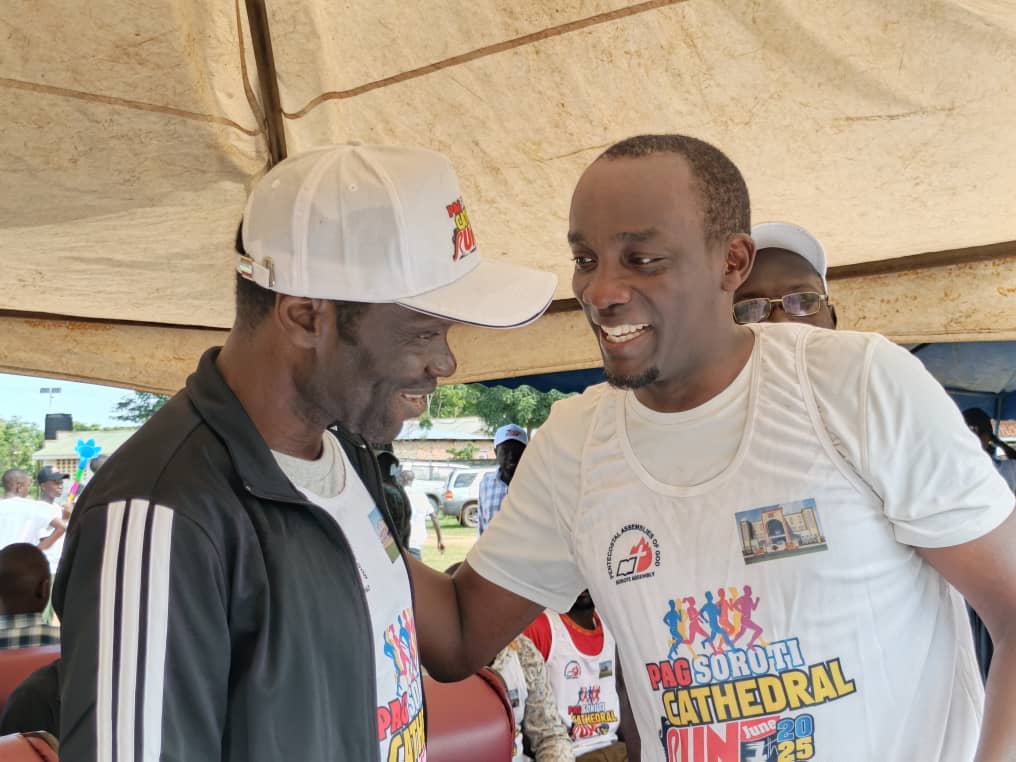
The unexpected meeting happened during at Soroti Sports Ground in Soroti City, where both men were in attendance.
What followed was a series of quiet but meaningful gestures, a prolonged handshake, a heartfelt embrace, and a one-and-a-half-minute conversation, that carried political significance far beyond the church walls.
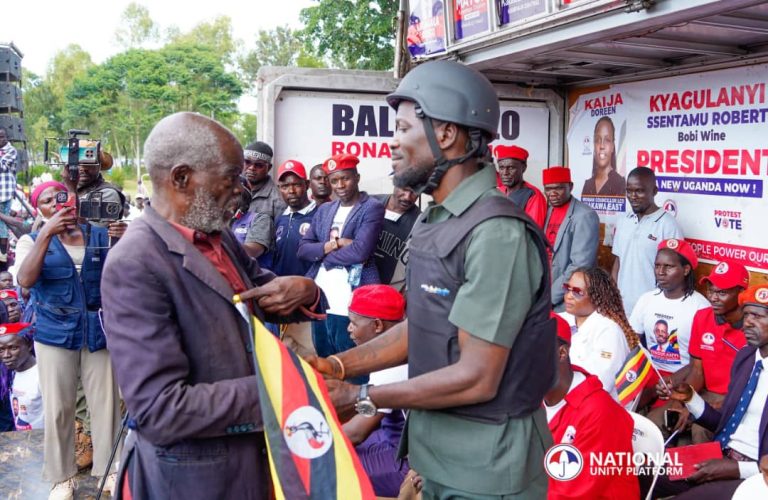
According to eyewitnesses and our on-ground reporter, Rodney Mukula, who is an aspirant for the Soroti City East parliamentary seat in the 2026 general elections, walked over to greet Echodu just after the run concluded.
The first handshake lasted approximately 50 seconds, marked by warm eye contact, gentle nodding, and what appeared to be a private but respectful exchange of words.
Moments later, Rodney returned to Echodu, and the two shared another handshake and a brief embrace that lasted nearly 40 seconds, an unusually warm and personal gesture for two individuals whose political ambitions could be seen as directly opposing.
Though the conversation was low-toned, our reporter, positioned within earshot, heard key phrases that revealed both cordiality and subtle political acknowledgement.
“You’ve done a lot for the region, and people are taking notice,” Rodney Mukula was heard telling Echodu. “I respect your efforts, and I genuinely wish you well, even as you go up against my father.”
For a moment, the busy Soroti Sports gorund fell into a quiet hum as congregants and political aides noticed the two men in conversation.
It was clear to many that this was no ordinary handshake it was a symbolic passing of the torch, or at the very least, a sign of mutual recognition between emerging forces within the NRM.
Echodu, known for his calm and thoughtful demeanor, smiled and nodded in appreciation.
Sources close to him say he later expressed his gratitude for the gesture, describing it as “the kind of leadership maturity the country needs.”
This moment of mutual respect comes at a time of heightened political interest in Eastern Uganda, particularly around the upcoming 2025 NRM CEC elections.
David Calvin Echodu, a prominent mobilizer and development advocate, has declared his intention to contest for the position of NRM Vice Chairperson for Eastern Uganda, currently held by Capt. Mike Mukula, Rodney’s father.
Echodu’s campaign is built around themes of reform, generational transition, internal party democracy, and the re-energizing of NRM structures from the grassroots to national levels.
In contrast, Capt. Mukula, who has held the CEC seat for several terms, is seen as representing the old guard of the party, experienced, influential, but increasingly challenged by younger aspirants seeking change.
Rodney Mukula’s open acknowledgment of Echodu’s political contribution and his willingness to wish him well, even in a race that involves his own father, struck many as a moment of political maturity that is often lacking in Uganda’s competitive political environment.
“This is how politics should be conducted, on the basis of respect, ideas, and vision, not hostility,” said Paul Okello, a local elder who witnessed the exchange. “Rodney showed that he is his own man, and Echodu showed that he commands respect, even from the son of his rival.”
Rodney Mukula, who has been quietly building support in Soroti City East, is also expected to launch his parliamentary bid later this year.
He has positioned himself as a forward-thinking, youth-oriented leader who is ready to build on his father’s legacy while bringing a modern edge to politics in the city.
Analysts say this interaction between Rodney and Echodu may not have been accidental.
It could mark the beginning of a new tone in NRM internal politics, where disagreements over positions do not have to translate into personal enmity or generational conflict.
The PAG Church in Soroti has long served as a neutral ground for community gatherings and spiritual reflection.
That it became the stage for this rare political moment only underscores the influence of faith spaces in Uganda’s public and political life.
About Author