
By Emmanuel Olinga
Usuk Senior Secondary School in Katakwi District has become the latest beneficiary of an ambitious environment conservation and sustainable development initiative spearheaded by Rotary Club International, with direct implementation by Rotary Club Soroti Central.

The multi-pronged project, valued at over UGX 220 million (USD 65,000), is set to revolutionize environmental education, agroforestry, and livelihood skills training for both students and teachers.
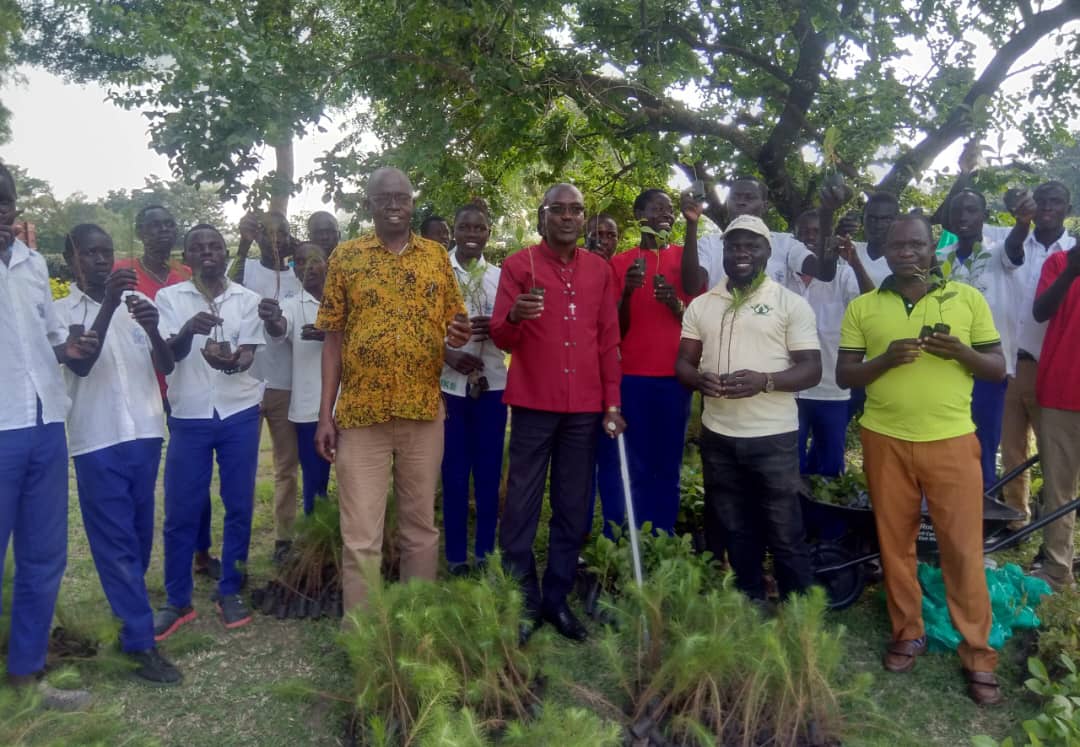
The initiative, which falls under Rotary Club International’s environmental conservation and economic empowerment agenda, was formally launched at the school this week.
Its core components include tree planting, agroforestry promotion, organic backyard farming, and skills training in sustainable and environmentally friendly technologies.

The project is part of a broader regional campaign that aims to integrate climate action into education while offering communities practical tools for income generation and environmental restoration.
Joseph Okiror, the Headteacher of Usuk Senior Secondary School, confirmed that the school has already begun reaping the benefits of the project.
These include the receipt of 4,235 assorted tree seedlings, the construction of a modern, energy-efficient kitchen, and capacity-building sessions for both students and teachers.
According to Okiror, the school received 900 pine seedlings, which will be planted on two acres of land, 235 Indian teak seedlings, and 3,100 eucalyptus seedlings, all supplied by the Yield Agric Agro Center based in Soroti.
“We are excited that Usuk SS has been selected as a pilot model school in Katakwi under this internationally funded project,” Okiror remarked.
“This intervention aligns perfectly with the current competence-based curriculum, which places emphasis on hands-on skills, entrepreneurship, and environmental stewardship.”
He noted that the newly constructed kitchen, equipped with energy-saving stoves, will significantly reduce firewood consumption, a major cost item in the school’s budget.
“We currently spend between UGX 1 million and UGX 3 million every three months on firewood. With the introduction of energy-saving stoves, we expect to redirect those funds to other pressing school needs,” he added.
The model school project emphasizes not only environmental conservation but also economic empowerment and sustainability.
Through agroforestry and backyard farming training, students and staff are being equipped with essential skills to grow nutritious foods organically and sustainably.
“This is not just about planting trees, it’s about changing mindsets,” said Joshua Opejo, Manager of Agro Soroti, the agency overseeing the technical implementation of the project.
“We are helping schools and communities understand the value of trees in ecosystem restoration and economic gain. Agroforestry, backyard farming, and organic produce are pillars of resilience in our climate-vulnerable region.”
Opejo explained that Usuk SS is serving as a pilot in the district and is expected to be a model for similar interventions in other schools across Teso and Eastern Uganda.
“The seedlings we delivered are selected for both their environmental benefits and market value. Pine, eucalyptus, and Indian teak are fast-growing species with long-term commercial potential,” he noted.
The initiative also includes infrastructure development, with the construction of a modern school kitchen seen as both a functional and symbolic upgrade.
Silvester Ocatum, Chairperson of the Board of Governors of Usuk Senior Secondary School, commended the Rotary Club Soroti Central for their foresight.
“The kitchen alone is a game changer,” Ocatum said. “Modern infrastructure, particularly in rural schools, inspires both learners and the community. It also reduces the workload on staff and promotes hygiene and energy efficiency.”
He added that the project sets a new direction for school development, especially under government pressure to meet education quality and environmental targets.
The project is expected to yield long-term benefits beyond the school gates. Local farmers, parents, and community members will also be involved in organic farming demonstrations and training sessions.
Rotary Club Soroti Central has committed to continue working with school authorities to ensure sustainability, including follow-up on tree growth, maintenance of the energy-saving kitchen, and continuous training of staff and learners.
“This partnership is about empowerment and legacy,” a representative from Rotary Club Soroti Central emphasized. “We are investing not just in trees, but in minds, futures, and resilience.”
About Author