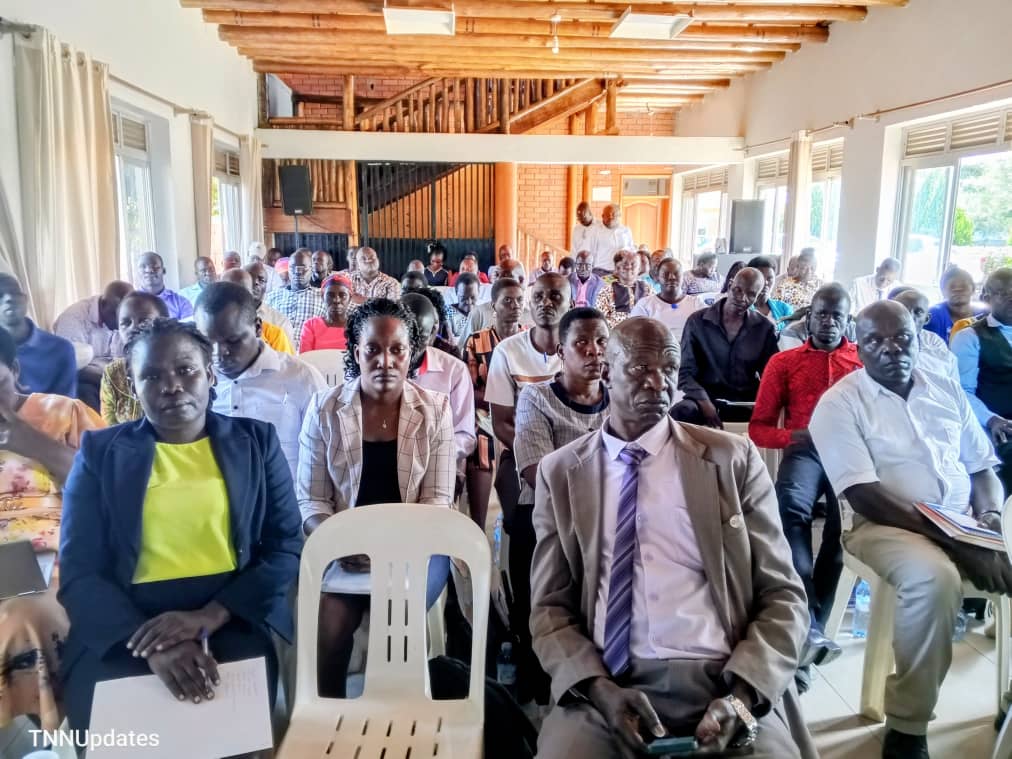
The Soroti District Local Government is holding a two-day budget conference for the Financial Year 2026/2027, held from November 6th to 7th at Nok-T gardens aiming development priorities, reviewing sub-county proposals, and preparing the district’s annual budget framework.
According to District Planner Richard Oboi, the conference marks a crucial stage in the budgeting process where all stakeholders including political leaders, opinion leaders, NGOs, civil servants, and the community come together to shape the district’s development agenda for the coming financial year.
“Developing a budget is not a one-man policy. It requires inclusiveness and participation. This is why we involve everyone from opinion leaders to NGOs to ensure transparency, accountability, and that the public understands how resources are used,” Oboi stated.
He noted that this year’s budget is guided by the National Development Plan and aligns with Uganda’s Vision 2030, which spans thirty years (2010–2030).
Soroti District’s new five-year development plan (2025–2030), valued at approximately UGX 57 billion, focuses on both capital and recurrent development programs.
Oboi added that the district expects to spend about UGX 37 billion in the 2026/27 financial year, with possible adjustments to UGX 40 billion at the time of approval and the funds will be allocated across key sectors such as agriculture, industrialization, education, health, and community development.
“This budget allows us to prioritize projects that are most critical to community growth and service delivery,” he added.
In his remarks, Soroti District LC5 Chairperson Simon Peter Edoru Ekuu announced a major partnership between the district and Giz a non government profit organization (NGO), aimed at enabling residents to register customary land at an affordable rate of UGX 85,000.
“We have agreed with Giz on a self-financing model where residents pay UGX 85,000 and, using our district technocrats including the lands officer, surveyor, and physical planner we help them register and secure their land,” Edoru explained.
He said this initiative will make land registration accessible to ordinary citizens who cannot afford expensive land titles, adding that it is the cheapest government-backed option currently available in Uganda.
“If fully embraced, this program could reduce land disputes by over 80%. We encourage the public to take advantage of it,” he emphasized.
Edoru also highlighted the importance of such budget conferences in ensuring equitable resource distribution across the district.
“This is the day leaders come together to plan and allocate resources fairly. It removes bias and ensures that no community is left behind in development,” he said.
Chief Administrative Officer (CAO) Elly Piwang described the conference as a “consultative and accountability forum” that not only reviews past performance but also charts a vision for the future.
He revealed that the theme for FY 2026/27 is:
“Full Monetization of Uganda’s Economy through Commercial Agriculture, Industrialization, and Digital Service Expansion.”
Piwang said the district’s 10-fold growth strategy will run up to 2040, focusing on key areas such as export promotion, seed multiplication, small-scale packaging industries, and building a knowledge-based economy that empowers farmers and cooperatives to access markets efficiently.
“We must focus on extension services, standardization, and building farmer capacity so that production is driven by knowledge and innovation,” he noted.
The CAO also announced new infrastructure projects planned for 2026, including five major roads and new markets in Dakabela and Katine sub-counties.
“We have already completed the Arapai–Tubur Road to boost production and connectivity, and we are set to construct 102 km of selected road networks starting January,” he revealed.
He praised the district’s successful implementation of the Parish Development Model (PDM), noting that Soroti is among the few districts where every village has beneficiaries.
“Our leaders have mobilized effectively, and every village in Soroti District now has a PDM beneficiary. This has reduced controversy and promoted inclusive growth,” Piwang added.
The conference was attended by several NGOs and development partners, including SOCADIDO, COU-TEDDO, PELUM Uganda, CIDI, CARITAS, and TIP, all of whom play vital roles in promoting sustainable agriculture, land advocacy, climate change resilience, food security, peacebuilding, and youth empowerment.
Piwang called on these organizations to continue working with local governments to strengthen local revenue generation for sustainable service delivery even after NGO interventions end.
“We must build systems that sustain themselves when development partners move on. Strengthening local revenue and mindset change is key,” he said.
About Author