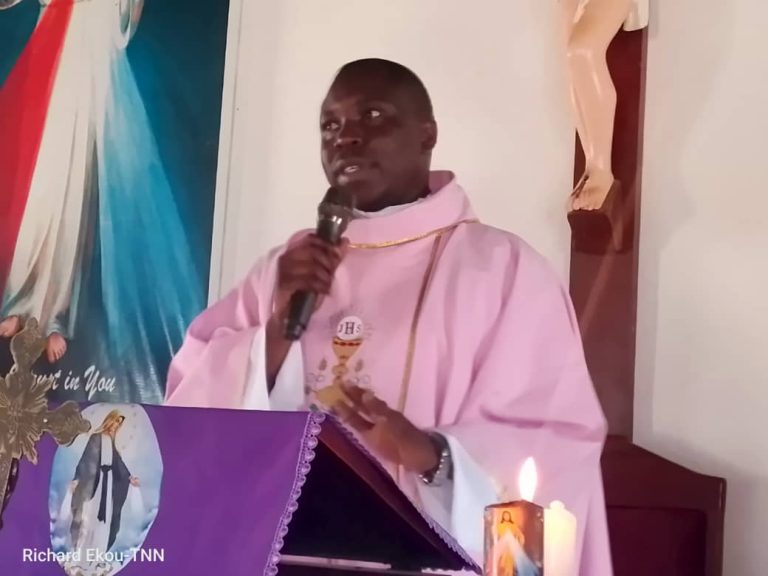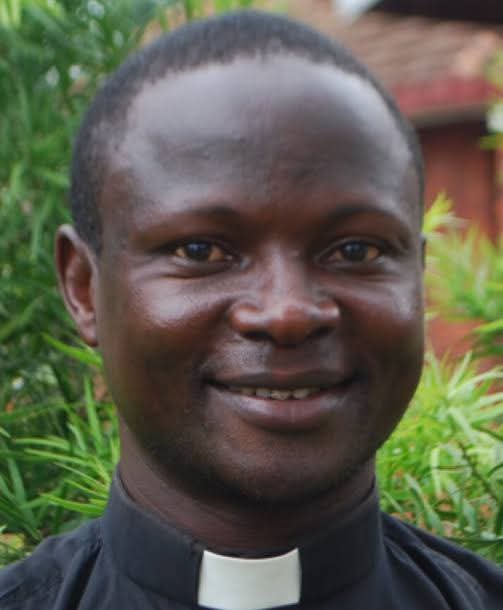
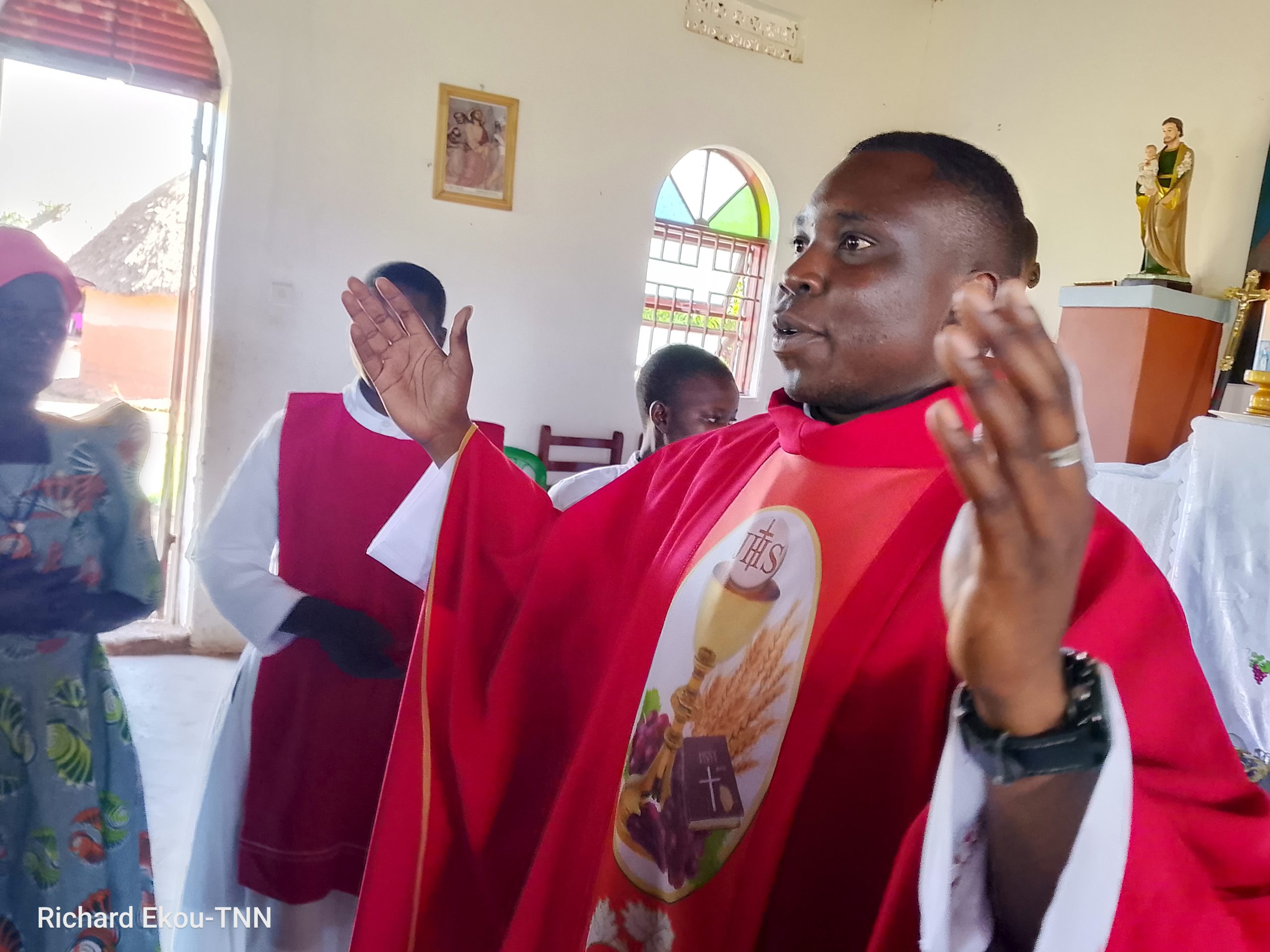
The Feast of the Exaltation of the Holy Cross was marked with deep spiritual reflection as Rev. Fr. Marcel Ajoket, parish priest of the Most Holy Name of Jesus Catholic Parish Dakabela and diocesan communications director, delivered a homily that challenged Christians to strengthen their faith by embracing the symbol of the cross as a guiding light in their daily lives.
Fr. Ajoket reminded the faithful that the cross is not merely a religious emblem but a living sign of Christ’s love, sacrifice and power.

He urged Christians to replace trivial symbols in their homes, such as drinking straws, with the sign of the holy cross as a constant reminder of God’s presence and enduring love.

“The cross is something of love, peace and power because anyone who sees the cross with hope will be saved,” he said.
According to him, the cross embodies the ultimate expression of Jesus’ love for the world. It is through the cross, he explained, that humanity witnessed God’s mercy and salvation.

Fr. Ajoket emphasized that Christians must not take the cross for granted but rather learn to adore and revere it as a source of hope and transformation.
Fr. Ajoket stressed that faith in the cross has the power to renew and redirect lives.
He called on Christians to cultivate a strong sense of hope and belief in the power of the cross, saying that genuine devotion to this sacred symbol can change the way believers face challenges and burdens.
“Let us be Christians who are dedicated and ready to offer all our burdens to the cross, a sign of love and victory,” he urged.
The priest highlighted the importance of keeping the cross within Christian homes. Having the symbol of the cross, he noted, serves as a constant reminder of Christ’s sacrificial love and provides comfort in times of difficulty.
Beyond the cross, Fr. Ajoket asked Christians to respect and uphold all symbols of the Church, as they play a vital role in strengthening faith and building unity among believers.
He warned against neglecting these spiritual signs, encouraging the faithful to recognize them as pathways to deeper reverence for God.
“Christians should have hope and respect the symbols of the Church, because they remind us of our faith and connect us to the mystery of Christ’s love,” he added.
Linking the message of the cross to daily Christian living, Fr. Ajoket appealed to the faithful to love one another just as Christ loved the world.
He said that authentic Christian living cannot exist without love, as love is at the heart of the Gospel.
He challenged the christians to reflect Christ’s compassion and kindness in their families, communities and workplaces, emphasizing that the cross is meaningless without genuine acts of love among believers.
Fr. Ajoket also encouraged Christians to cultivate an attitude of gratitude even in times of trial.
He reminded the faithful that hardships should not lead to blaming God, but rather to deeper trust in His providence.
He illustrated this with the example of the Israelites in the Old Testament, who, after being rescued from slavery in Egypt, grumbled and blamed both Moses and God for their hardships in the desert.
The priest urged believers not to fall into the same trap, but to turn their suffering into an opportunity to glorify God.
In his conclusion, Fr. Ajoket described the cross as a sign of victory over sin and death, urging Christians to anchor their lives in its meaning.
He called for steadfast devotion, unshakable hope and a spirit of surrender to God’s will.
“Above all, the cross remains a powerful reminder that God’s love conquers all,” he said. “Let us embrace it with faith and let it guide our lives towards peace, love, and victory.”
About Author