
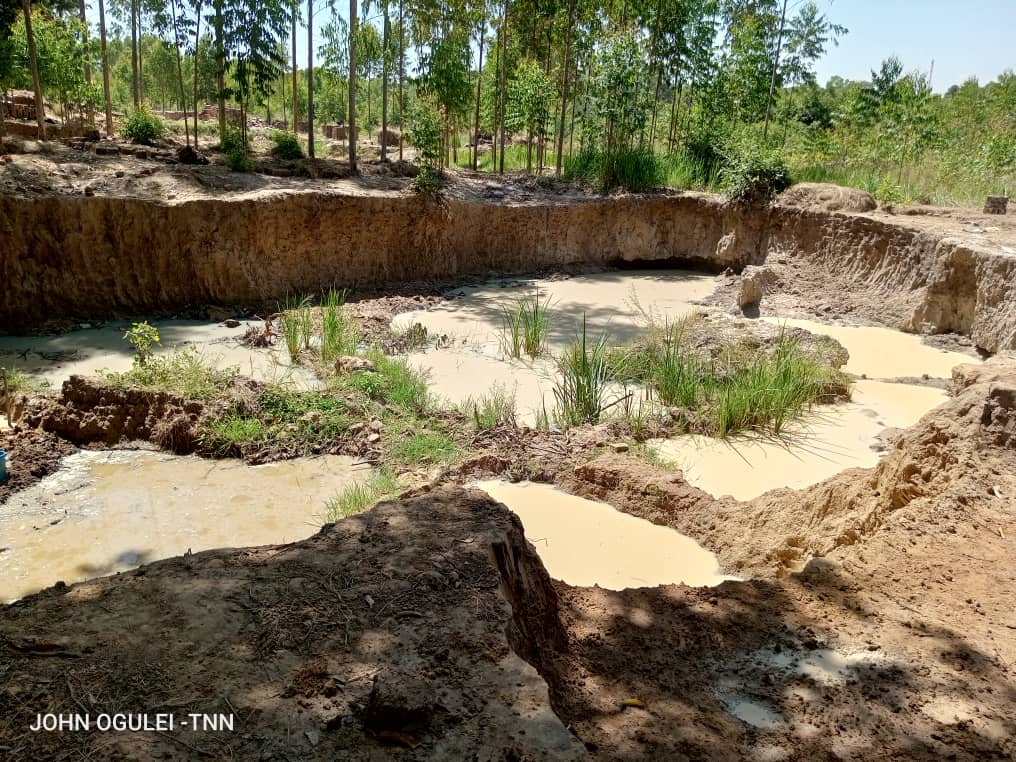
The National Forestry Authority (NFA) has commenced preparations for a massive restoration and tree-planting exercise in its forest reserves around Soroti City.
The initiative targets four key forest reserves including; Gweri Block, Madera Block, Prison Spring Block, and Lale Block and is part of a broader agenda to restore degraded forest land and protect the city’s natural ecosystem.

However, the process has sparked tensions, with hundreds of residents facing displacement.

The Area Forest Supervisor for Soroti, Abigaba Nazzifa, stated that NFA has begun groundwork, including boundary verification, in preparation for tree planting scheduled for March 2025, once the rainy season sets in.
“Today, we are working in some of the blocks in Soroti Central Forest Reserve. We are preparing for restoration and planting,” Nazzifa said.

“We reopened boundaries on July 1st this year, particularly in Gweri Block, and we are now inspecting these areas to ensure a smooth process for restoration.”
The tree-planting initiative aims to rejuvenate the city’s natural resources, which have been threatened by encroachment and urban expansion.
She emphasized the ecological importance of these reserves, particularly in maintaining Soroti’s environment as the city grows.
“Being a city with high land pressure, encroachment is a challenge,” Nazzifa noted.
“We have already observed houses and crops within the reserves, but these residents are aware they are living on forest land. This exercise is part of a national effort to restore such areas.”
Otim Joseph, the NFA Manager for Soroti, reinforced the government’s firm stance on protecting forest reserves.
He highlighted that the restoration aligns with national policies aimed at safeguarding environmental resources.
“There are legal frameworks and guidelines in place,” Otim stated.
“We want people to be responsible citizens. Soroti is fortunate to have eight forest blocks gazetted for forest purposes, covering hundreds of acres. Many cities do not have such resources. Government will not lose even a piece of this land.”
Otim added that while the government values human settlements, the forests play a critical role in maintaining a balanced ecosystem, mitigating climate change, and supporting livelihoods.
“I request those residing in these blocks to voluntarily vacate before March 2025. We advocate for voluntary compliance to avoid forceful evictions, which would be a last resort. This restoration is for the benefit of everyone residents and the environment alike,” he stated.
He said NFA has engaged with local leaders, including Local Council (LC) officials, to raise awareness about the impending restoration exercise.
Meetings have been held to discuss the importance of protecting forest land, with calls for collaboration between authorities and the affected communities.
Despite NFA’s call for voluntary relocation, residents living in the contested areas have voiced frustration and concerns over the process.
Among the affected residents is Okwali Jafar, who has lived on the disputed land since 1979.
He explained that the area was formally planned by Soroti authorities in 1998 when the city was still a municipality.
“We are surprised that NFA came this year and planted boundary stones without consulting us. They were accompanied by soldiers and policemen, which intimidated us. We expected them to return and talk to us, but they never did. It’s good they are here now at least we can discuss and understand where their boundaries truly are,” Okwali said.
For Okwali and many others, the lack of clear communication and consultation prior to boundary demarcation has fueled mistrust.
Another resident, Julius Esiya, questioned the legitimacy of NFA’s actions, particularly the process of planting boundary markers without verifying existing landmarks.
“They came and planted stones without showing us the actual demarcation lines,” Esiya said.
“I asked one officer whether planting stones means opening boundaries. If NFA truly knew their boundaries, they should have shown us where they start and end instead of planting new markers.”
Esiya added that residents were not necessarily opposed to the restoration efforts but emphasized the need for proper dialogue and fairness.
“My grandmother gave me a piece of land where I built my house. When NFA officers came, I asked if I could continue roofing my house, and they said yes. Now, we are waiting for them to come and clarify matters. We are willing to talk, but let them sit down with us and explain everything clearly,” he stated.
The situation in Soroti City highlights a recurring challenge across Uganda: balancing the need for environmental conservation with the realities of human settlement.
Urban expansion and population pressure have led to increasing encroachment on forest reserves, complicating NFA’s mandate to protect these critical resources.
Environmentalists argue that restoring degraded forests is essential for mitigating the effects of climate change, conserving biodiversity, and ensuring sustainable development.
Forests play a pivotal role in regulating the local climate, controlling floods, and providing resources such as firewood and medicinal plants.
However, the restoration process often faces resistance, particularly in urban areas where land is scarce and disputes over ownership are common.
Residents argue that they have occupied these lands for decades, with local authorities historically recognizing their presence.
This raises questions about land governance and the need for clear, transparent processes when reclaiming forest reserves.
However, experts suggest that successful restoration efforts require a community-centered approach that considers both environmental needs and human livelihoods.
The NFA’s plan to restore and plant trees in Soroti City’s forest reserves marks a significant step in safeguarding the city’s environment.
However, the process must address the concerns of affected residents, many of whom have lived on the land for decades.
About Author







Good take . I need too a job in forest planting. I have been in forest management for 7yrs