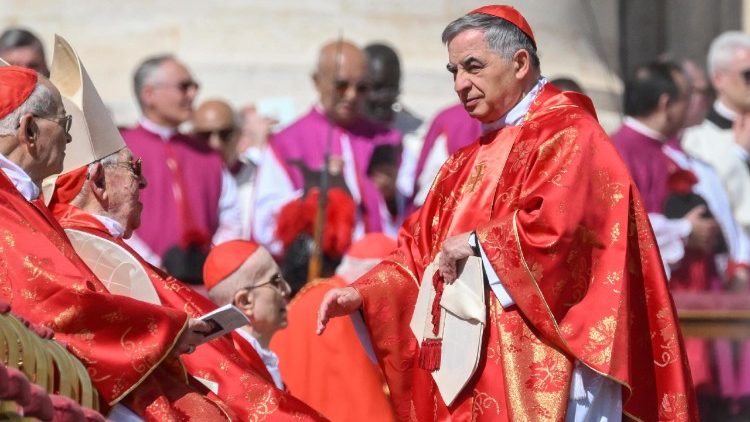
In a development that adds a notable dimension to the upcoming papal conclave, Italian Cardinal Giovanni Angelo Becciu announced on Tuesday that he will not take part in the proceedings scheduled to begin on May 7.
The decision, outlined in a public statement, follows years of tension surrounding the Cardinal’s involvement in a high-profile Vatican financial scandal.

Cardinal Becciu, 76, declared that his decision stems from a desire to preserve the unity and peace of the Church during a critical period of transition.

“Having at heart the good of the Church, which I have served and will continue to serve with faithfulness and love, and in order to contribute to the communion and serenity of the conclave, I have decided to obey, as I have always done, the will of Pope Francis not to enter the conclave, while remaining convinced of my innocence,” Becciu wrote.
This marks a significant moment in Church history, as Becciu becomes one of the few cardinals in modern times to voluntarily exclude himself from a conclave, the sacred gathering in which cardinals under the age of 80 elect the next Pope.
His renunciation reflects lingering fallout from legal proceedings that have clouded his service in the Roman Curia.
Once a close aide to Pope Francis and Prefect of the Congregation for the Causes of Saints, Cardinal Becciu was abruptly dismissed from his post and stripped of cardinalatial privileges in September 2020 amid allegations of financial misconduct, including his involvement in controversial investments using Church funds.
The charges, which he has consistently denied, included embezzlement and abuse of office.
The trial, which spanned more than two years, concluded in late 2023 with a mixed outcome: while some charges were dropped, others led to convictions, though appeals remain ongoing.
Despite legal setbacks, Becciu has remained vocally committed to his innocence and loyal to Pope Francis, who nevertheless maintained restrictions on his participation in Church governance.
While the late Pope Francis initially elevated Becciu to the cardinalate and entrusted him with significant responsibilities, the relationship between the two appeared to strain following the emergence of financial irregularities.
Still, Becciu’s statement suggests a continued reverence for Francis’ authority and a willingness to subordinate personal ambitions to the broader needs of the Church.
Observers note that Becciu’s decision could help ease tensions among electors ahead of what is expected to be a highly consequential conclave.
With the Catholic Church navigating numerous internal and external challenges, including questions around reform, decentralization, and accountability, unity among the cardinals will be critical in selecting a new pontiff to carry forward Pope Francis’ legacy.
With Becciu’s absence, 119 cardinals remain eligible to vote in the conclave, which will be held under strict confidentiality in the Sistine Chapel.
About Author