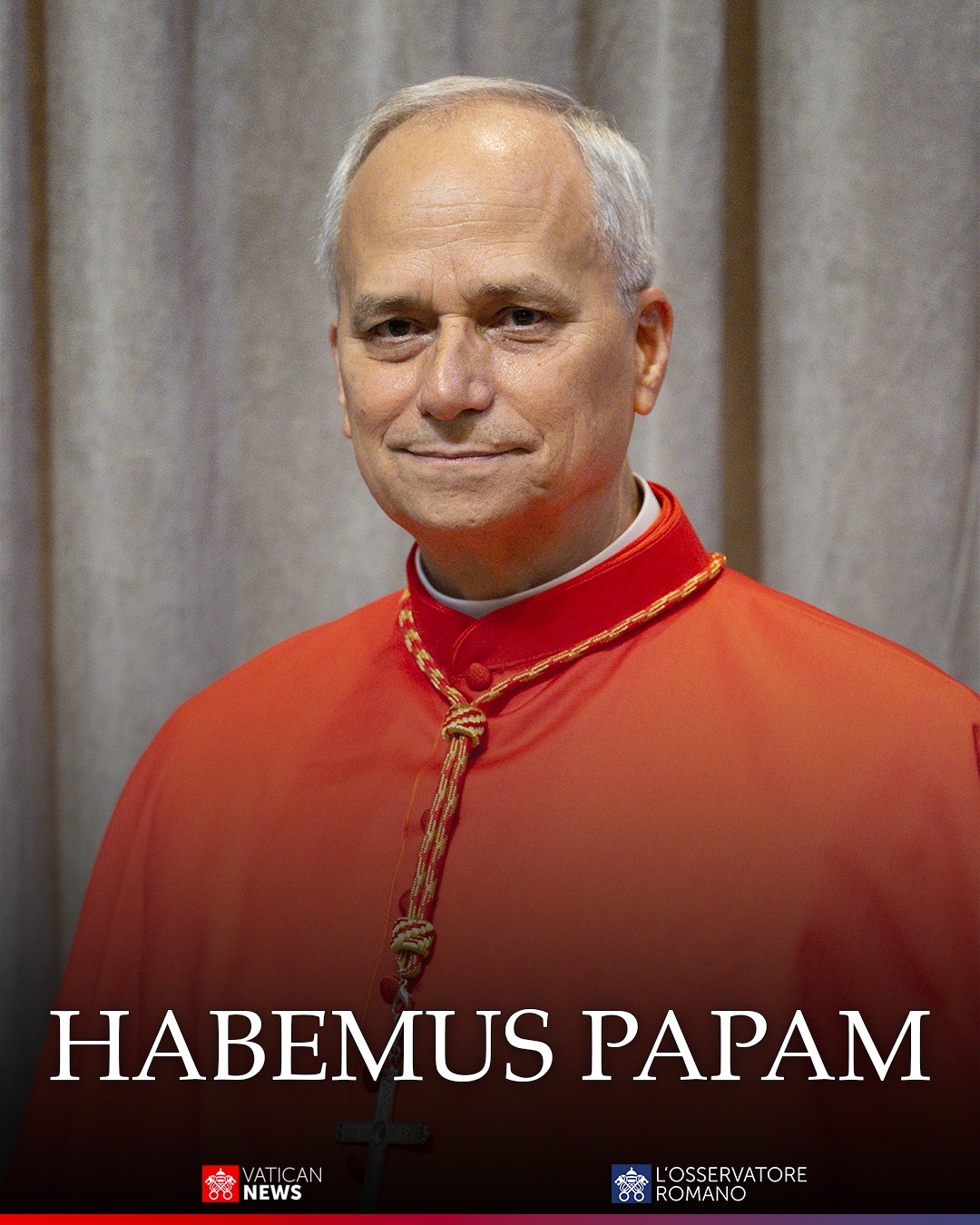
The bells of St. Peter’s Basilica rang out in jubilation today as the world heard the time-honored proclamation: “Habemus Papam!”.
The College of Cardinals, after several days of closed-door deliberations in the Sistine Chapel, has elected Cardinal Robert Francis Prevost as the 267th Pope of the Roman Catholic Church.

The 69-year-old American-born prelate chose the name Pope Leo XIV, reviving a name last used in 1903.

The announcement came shortly after white smoke billowed from the chimney of the Sistine Chapel, signaling to thousands gathered in St. Peter’s Square, and to millions watching worldwide, that a new spiritual leader had been chosen.
The Vatican’s protodeacon, Cardinal Jean-Pierre Ricard, stepped onto the central balcony of the basilica to formally introduce the new pope to the world.
“Annuntio vobis gaudium magnum: Habemus Papam!” he declared. “Eminentissimum ac reverendissimum Dominum, Dominum Robertum Franciscum Prevost, qui sibi nomen imposuit Leo Quartus Decimus.”
Moments later, Pope Leo XIV appeared before the crowds, dressed in the traditional white cassock and papal stole.
With a calm but commanding presence, he offered his first papal blessing, Urbi et Orbi, to the city and to the world.
Born in Chicago, Illinois, in 1955, Robert Francis Prevost entered the Order of St. Augustine and was ordained a priest in 1982.
His pastoral journey took him from the United States to Peru, where he served for years as a missionary and bishop.
Most recently, he held a key position in the Roman Curia as the Prefect of the Dicastery for Bishops, earning the respect of many within the Vatican for his theological depth, administrative skill, and pastoral sensitivity.
His international experience and command of multiple languages positioned him as a unifying figure, capable of bridging the Church’s traditional strongholds in Europe and the increasingly vibrant communities in the Global South.
His election reflects the Cardinals’ desire for a Pope who understands the global face of Catholicism in the 21st century.
In choosing the name Leo XIV, the new pope aligns himself with a lineage of reformers and peacemakers.
Pope Leo XIII, who served from 1878 to 1903, is especially noted for his intellectual engagement with modernity and his groundbreaking encyclical Rerum Novarum, which laid the foundation for modern Catholic social teaching.
Observers believe Pope Leo XIV may seek to echo this legacy by addressing urgent social and moral challenges, climate change, economic inequality, and the ethical use of technology, while shepherding a Church facing internal divisions and declining attendance in some regions.
In his brief inaugural address, Pope Leo XIV called for renewed unity in a time of global uncertainty.
“Let us walk together,” he said, “as pilgrims of peace, justice, and fraternity. May the Church be a refuge for the weary, a beacon for the lost, and a servant to all.”
He thanked his predecessor, Pope Emeritus Francis, for his decade of service marked by humility, outreach to the marginalized, and reform of Church structures.
“We build on strong foundations,” he said, gesturing toward the path ahead with cautious optimism.
In the coming days, Pope Leo XIV will meet with Vatican officials and begin setting priorities for his pontificate.
A formal inauguration Mass is expected to take place in St. Peter’s Square within the week, drawing heads of state, religious leaders, and faithful pilgrims from around the globe.
The eyes of the world now turn to the Vatican, not just to witness the beginning of a new papacy, but to see how this new Pope, an American missionary turned global shepherd, will lead the Church into its next chapter.
About Author