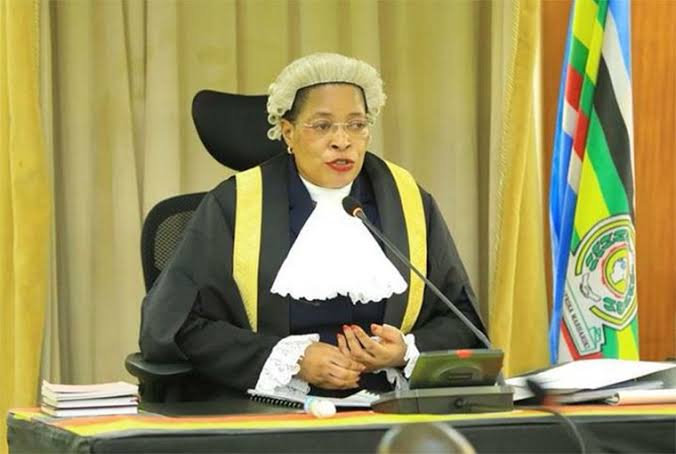
Uganda’s Speaker of Parliament Rt. Hon. Anita Annet Among has directed the Ministry of Health to prioritize and allocate funds for the construction of a new Soroti Regional Referral Hospital, citing alarming inadequacies at the current facility and the need to match health infrastructure with Soroti’s new city status.
Speaker Among, clearly concerned about the deplorable state of healthcare delivery in Soroti, stated that what is officially designated as a “Regional Referral Hospital” is, in reality, no more than a small general hospital, overwhelmed and overstretched beyond its capacity.

“Actually, we don’t have a referral hospital,” she said. “That small hospital in the middle of town has no space for expansion and lacks even basic equipment. You stand at the gate and are welcomed by a strong smell, they don’t even have vehicles to remove garbage. It’s a shame.”

She emphasized the gravity of the situation by noting that the facility cannot conduct major operations due to the absence of a functional surgical theater, raising concerns about patient safety and access to critical care in the region.
“It’s a very serious matter,” she stressed, before calling on the Ministry of Health to urgently rectify the situation.

“You need to now build a proper referral hospital or at least change the name of the current one back to Soroti General Hospital because it does not meet the standards.”
The Speaker’s directive puts a spotlight on the broader issue of regional health infrastructure in Uganda.
As cities expand and populations grow, many health facilities have not been upgraded to meet the new demands.
Soroti City, having attained city status in 2020, is now grappling with the same infrastructural limitations that plague many newly urbanized centers across the country.
The current Soroti Regional Referral Hospital was originally established to serve a smaller population and lacks both land and modern facilities to serve as a true referral hospital.
Health workers in the region have long decried the limited resources, lack of diagnostic equipment, and chronic congestion that affect service delivery.
Local leaders and residents have welcomed Speaker Among’s intervention, noting that the situation has been dire for years but without concrete government action.
“We need a proper facility that reflects the status of Soroti as a city and serves the entire Teso Sub-region,” said a senior medical officer who preferred anonymity. “This hospital cannot even handle basic surgeries. Patients are often referred to Mbale or Kampala.”
Speaker Among’s remarks also raise broader questions about the Ministry of Health’s prioritization of funding and its commitment to decentralizing quality healthcare.
Despite the National Health Policy aiming to ensure equitable access to essential services for all Ugandans, many regional facilities continue to operate below standard, burdened by underfunding, poor maintenance, and lack of specialized staff.
The Ministry of Health, in its most recent sector performance report, acknowledged that while strides have been made in improving maternal health and immunization, infrastructure development remains a significant bottleneck.
The Uganda Health Sector Development Plan (HSDP II 2020/21 – 2024/25) aims to upgrade at least one hospital in every sub-region to referral status. However, implementation has been inconsistent due to funding shortfalls.
Parliament’s Budget Committee has in recent sessions flagged the Ministry for underutilization of funds and delayed execution of capital development projects, especially in the health sector.
Speaker Among’s directive now puts pressure on the Ministry to realign its priorities and demonstrate visible progress in regions such as Teso.
Speaker Among’s intervention reflects the increasing role of Parliament in monitoring, evaluating, and influencing service delivery at the grassroots.
Parliament has, in recent years, become a vital platform for communities to raise concerns about public health access, especially in under-served regions.
It is expected that the Parliamentary Committee on Health will follow up on this matter and push for the inclusion of funds in the upcoming supplementary budget.
As Uganda continues to implement Vision 2040 and the National Development Plan III, health remains one of the key pillars for achieving social transformation.
The situation in Soroti underscores the need for decentralized investment in health, not just in physical infrastructure but also in staffing, equipment, and supply chains.
If the Ministry of Health heeds Speaker Among’s call, the construction of a new Soroti Regional Referral Hospital could serve as a model for upgrading health infrastructure in other emerging cities such as Lira, Hoima, and Mbale.
About Author