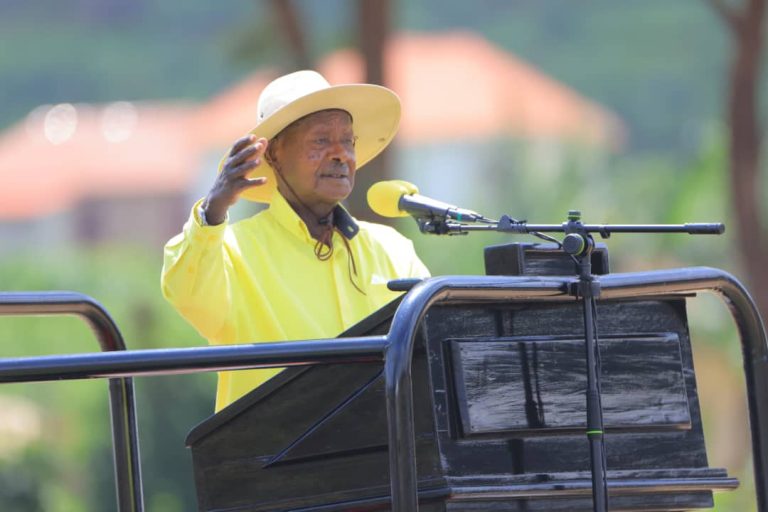

Uganda’s President Yoweri Kaguta Museveni has issued a clarion call to global stakeholders in the aquaculture industry to form meaningful partnerships with Uganda, East Africa, and Africa at large to transform the sector into a modern economic powerhouse.
His message was delivered by Vice President H.E. Jessica Alupo at the opening ceremony of the World Aquaculture Safari Conference held at Speke Resort Munyonyo on Wednesday, June 25, 2025.

In forward-looking address, President Museveni noted that aquaculture remains one of the most fragile yet economically vital subsectors in agriculture, and that its development is not only essential for Uganda’s economic progress but also for the prosperity of the entire African continent.

“I, therefore, call upon all stakeholders in aquaculture to partner with Uganda, East Africa and Africa at large to develop this industry,” Museveni stated.
“I hail all those that have already chosen Uganda as the best destination for investment in the fisheries industry. Uganda boasts of a robust economy, good climatic conditions, and favorable policies that enable investors to realize profits in the shortest period of time.”

The President commended the World Aquaculture Society and its organizing partners for bringing this year’s global conference to Uganda, a feat he described as a sign of confidence in the country’s leadership, peace, and potential.
Uganda is only the second African country after South Africa to host this prestigious conference, which has attracted delegates from 58 countries and more than 1,000 participants.
Reflecting on Uganda’s journey since the National Resistance Movement (NRM) took power in 1986, Museveni recounted the challenges faced by the fisheries sector at the time and the strategic interventions that have transformed it from a subsistence activity to a commercially viable enterprise.
“By 1986, the economy had collapsed; and the few existing industries had closed. The few people who were in the fish sector regarded it as a subsistence activity, meant for food and not commercial purposes,” he explained.
“The first step that the NRM took to revamp the fish sector was to attract investors into the sector and since then Uganda has registered remarkable success.”
He said the Government of Uganda has invested in a range of interventions to revitalize the industry, including the enforcement of fisheries regulations through the deployment of armed forces to curb illegal fishing practices.
As a result, Uganda currently produces 658,000 metric tonnes of fish annually, sustaining operations of 12 fish processing factories.
The value of fish and fish products exported has risen from USD 148.7 million in the 2020/21 financial year to USD 152.8 million in 2023/24.
Museveni also stressed the need for regional integration and Pan-African collaboration to ensure aquaculture and other sectors benefit from a united market and shared resources.
“We must consolidate our efforts toward regional and continental market integration and work together as a bloc. The NRM advocates for Pan-Africanism because we are convinced that it can accelerate the growth of all sectors of the economy,” he noted.
He pointed the need for expansion of the East African Community (EAC), which now includes Burundi, Somalia, South Sudan, and the Democratic Republic of Congo.
State Minister for Fisheries and Serere District Woman MP, Hon. Hellen Adoa, emphasized that the World Aquaculture Safari Conference presents an unprecedented opportunity for Africa’s aquaculture revolution.
She pointed out that Uganda is hosting over 1,000 delegates, signaling global trust in Uganda’s peaceful and business-friendly environment.
“This is the biggest global congregation of diverse actors in the aquaculture network, and it is a great honor for Uganda to be only the second African country to host it,” Adoa said.
 “The World Aquaculture Safari presents an opportunity to highlight Africa’s emerging aquaculture sector. It enables us to showcase Africa-led research, innovation, ambition, and commercial opportunities.”
Adoa emphasized that the sub-sector plays a critical role in bridging the nutritional gap caused by declining wild fish stocks, and it continues to provide food, employment, and household incomes to millions.
“At the country level, Uganda is endowed with great potential, given that 20% of its surface area is freshwater. We currently produce over 120,000 metric tonnes annually from aquaculture, but our policy target is to reach one million tonnes per year in the long term,” she said.
According to Adoa, the Ministry of Agriculture, Animal Industry and Fisheries (MAAIF) has prioritized aquaculture among the top six interventions for medium- and long-term growth.
The common systems include pond-based extensive and semi-intensive production, and cage culture, particularly on Lake Victoria.
She added that the ongoing conference aligns with several regional and continental blue economy frameworks, including those of the EAC, IGAD, COMESA, and the African Union, that promote sustainability, gender and youth inclusion, and regional trade.
Adoa encouraged the private sector to take advantage of Uganda’s conducive investment environment, highlighting the presence of pioneer investors such as Yalelo, De Heus, and IG Invest, who are actively involved in fish production and feed processing.
She further urged increased collaboration in research and innovation across African and global networks, warning against fragmentation and calling for stronger intra-African trade to match supply with demand across regions.
“We should not be fragmented. We should promote intra-African and global trade to ensure that the countries with greater competitive advantage in aquaculture use that opportunity to supply and feed the underserved areas,” she emphasized.
In her welcome remarks delivered on behalf of the Permanent Secretary of MAAIF, Under Secretary Mrs. Aacha Mary Orikiriza reiterated government’s commitment to aquaculture.
She pointed out that Uganda’s water resources are underutilized and the government plans to scale up commercial aquaculture through targeted research and increased fish pond investment.
“We are prioritizing aquaculture in the National Development Plan IV (NDPIV), the Parish Development Model (PDM), and other national frameworks. Our goal is to ensure that aquaculture significantly contributes to national food security, income generation, and economic transformation,” she said.
Conference Chairperson Dr. John Malakira commended the farmers who turned up in large numbers to attend the event.
He noted that their interaction with researchers will be vital in identifying and resolving the real challenges facing aquaculture at the grassroots.
Dr. Malakira also stressed the importance of including students and youth in aquaculture development.
“Young people must be part of this transformation. Aquaculture holds promise not just for food security but for scientific innovation and economic independence. I thank the organizing committee for bringing this event to life and giving a voice to every stakeholder in the aquaculture value chain,” he concluded.
The conference provides a platform for forging partnerships, sharing best practices, identifying funding opportunities, and setting policy directions for sustainable fisheries and aquaculture development.
In officially declaring the World Aquaculture Safari Conference open, President Museveni, through Vice President Alupo, expressed confidence that the ideas and resolutions arising from the event would yield tangible results.
“I believe the deliberations will benefit us all for a common good,” Museveni said.
With global eyes now set on Uganda, and its waters brimming with untapped potential, the East African nation has firmly positioned itself as a gateway to Africa’s blue economy revolution.
About Author