Uganda’s State Minister for Fisheries, Hon. Hellen Adoa, has called on East African states to adopt a united and sustainable approach in addressing the growing threats to Lake Victoria’s fisheries sector.
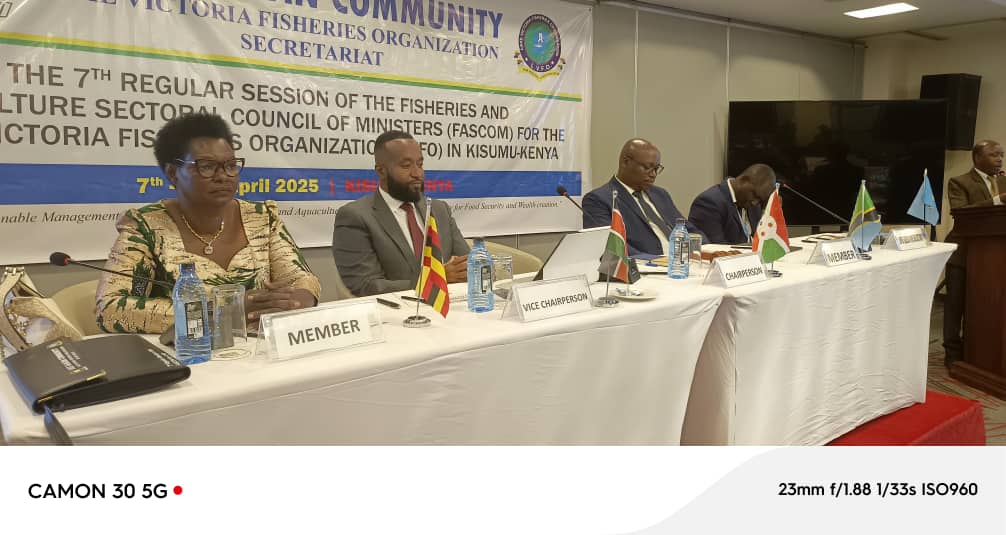
Adoa, who also serves as the Serere District Woman Member of Parliament, made the remarks while delivering the keynote address at the 7th regular Session of the Fisheries and Aquaculture Sectoral Council of Ministers (FASCOM) for the Lake Victoria Fisheries Organization (LVFO) held in Kisumu, Kenya, from April 7th to 11th, 2025.

In her speech, Hon. Adoa expressed deep concern over the increasing levels of illegal, unreported, and unregulated (IUU) fishing activities on Lake Victoria, which she said are contributing to the rapid degradation of vital fisheries resources shared by Uganda, Kenya, and Tanzania.

“I am duly aware that Lake Victoria Fisheries is faced with a number of challenges, mainly the illegal, unreported, and unregulated fishing activities on the lake that have led to continuous degradation of fisheries resources,” she said. “This is not only harmful but undesirable and unsustainable.”
She emphasized the urgent need for regional cooperation and coordinated action to combat IUU fishing, enforce regulations, and invest in sustainable fishing practices.

According to the minister, without a collective regional strategy, the future of the lake’s fisheries and the livelihoods of millions of people who depend on them remain at risk.
“I invite all of you to join me to devise a lasting solution to these and the many pending challenges to the Lake Victoria Fisheries Organisation,” Adoa urged fellow ministers and stakeholders.
The 7th LVFO FASCOM session brought together ministers and technical experts from Uganda, Kenya, and Tanzania, along with regional and international development partners, to discuss policy directions, harmonized management strategies, and the implementation of sustainable aquaculture development projects.
LVFO, a specialized institution of the East African Community (EAC), plays a critical role in the sustainable management and development of fisheries resources in Lake Victoria.
Its work supports national and regional food security, job creation, and the conservation of aquatic biodiversity.
During the session, participants reviewed progress on regional fisheries management plans, strategies to counter IUU fishing, and frameworks for enhancing data sharing and enforcement collaboration among the partner states.
About Author