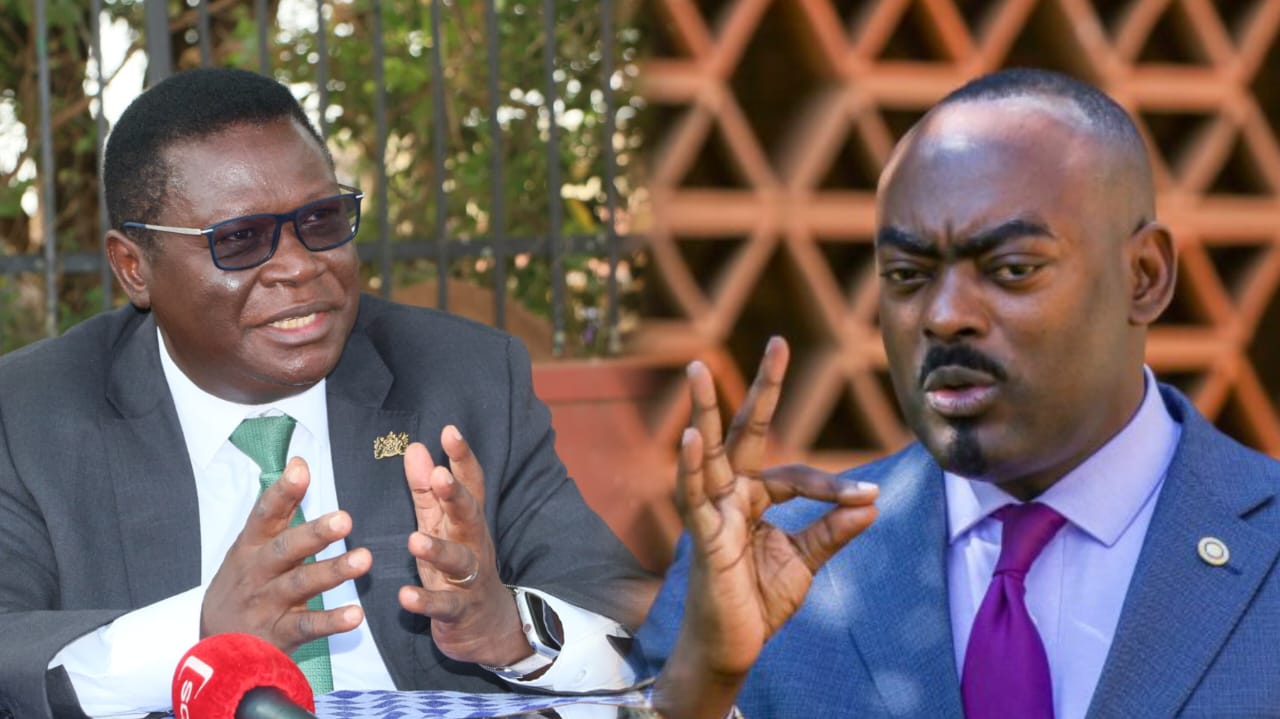
The Democratic Party (DP) President General and Minister for Constitutional Affairs, Norbert Mao, and DP Vice President Fred Mukasa Mbidde clashed in front of party delegates during an ongoing conference in Soroti City over the controversial NRM-DP Cooperation Agreement.
The agreement, signed on July 20, 2022, at State House Entebbe, was meant to formalize political collaboration between DP and the ruling National Resistance Movement (NRM).
A key outcome of the agreement was Mao’s appointment as Minister for Justice and Constitutional Affairs. However, internal divisions within DP have persisted, with many party members questioning the benefits of the arrangement.

During the heated session, Mbidde tabled a motion calling for the termination of the cooperation agreement, arguing that NRM has not honored its commitments.
He insisted that while an agreement exists, there has been no real cooperation between the two parties.
“I presented the motion that the Democratic Party issue a notice to the National Resistance Movement to justify why the cooperation agreement should not be terminated,” Mbidde stated.
He particularly cited Clauses 3 and 4 of the agreement, which outline the framework for collaboration.
“There is evidence that we signed an agreement, but there is no evidence that we are actually cooperating. Cooperation entails dialogue on national matters such as Uganda’s political transition, human rights, and electoral reforms, issues that remain unresolved,” he emphasized.
Mbidde further criticized the way DP leaders are treated under the agreement, likening it to an unequal partnership.
“Imagine being in a marriage where one side refuses to acknowledge the other,” he said metaphorically, suggesting that DP had been reduced to a mere extension of the NRM rather than a respected ally.
In response, Mao defended the agreement, arguing that the party must remain committed to dialogue and cooperation rather than seeking immediate termination.
“Meetings are meant for discussions, and disagreements are normal. My role as party leader is to foster consensus, not division,” Mao said while addressing the press at Soroti Hotel.
He dismissed the notion that DP had lost its identity, instead insisting that political cooperation is a strategic move for long-term influence.
“If I cannot build consensus within DP, how can I build consensus in Uganda?” he questioned.
Mao acknowledged concerns about the agreement’s implementation but maintained that DP must work to ensure its demands are met rather than abandon the arrangement altogether.
“There are disagreements even in churches, but that does not mean we should break away. Leaders must be prepared to manage crises and find solutions,” he said.
The clash between Mao and Mbidde underscores the deep divisions within DP regarding its relationship with NRM.
The two opposing motions, one for termination and another for reviewing the cooperation, have been referred to the National Council for further deliberation.
The NRM-DP agreement was signed with the promise of mutual cooperation on governance matters, including parliamentary support on key policies.
Mbidde and other senior DP members believe that continuing the agreement weakens the party’s independence and credibility, particularly among opposition voters.
On the other hand, Mao insists that staying in the agreement offers a unique opportunity for DP to influence government policies from within.
The National Council’s decision in June will determine the fate of the DP-NRM Cooperation Agreement.
About Author