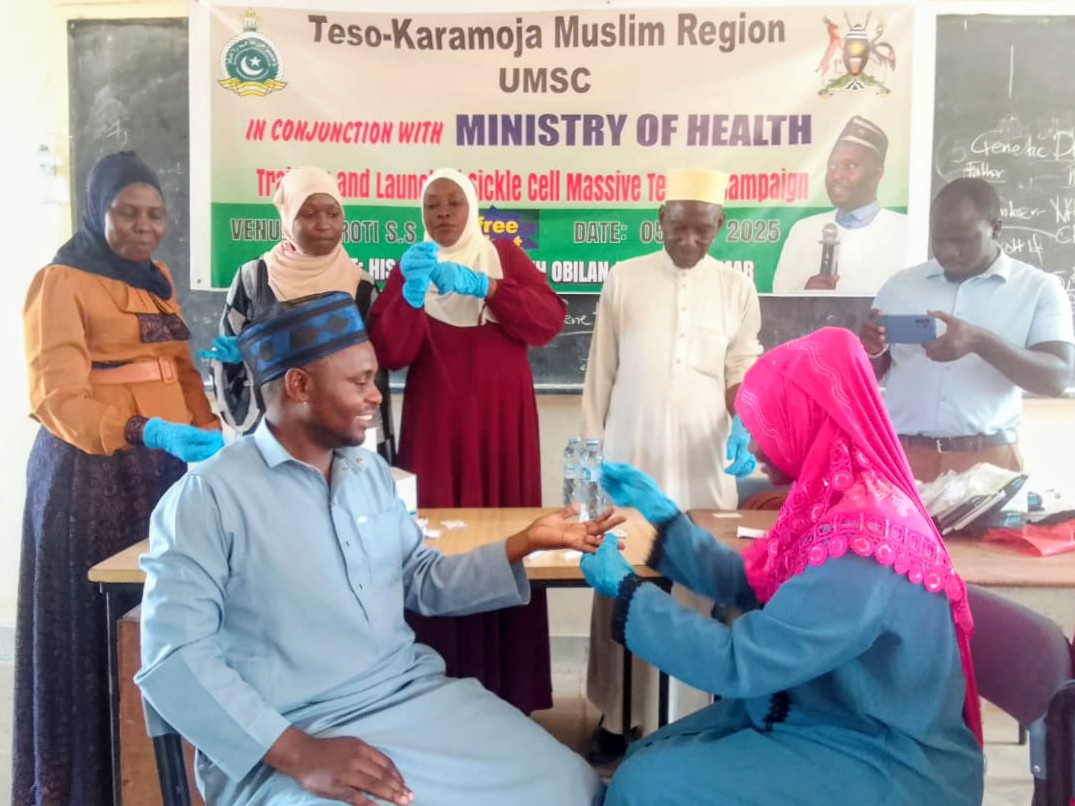
The fight against sickle cell disease in Eastern Uganda has gained fresh momentum after Sheikh Abubakar Umar Obilan, the Regional Assistant Mufti (RAM) for Teso–Karamoja Muslim Region, launched a major sickle cell massive testing campaign aimed at boosting early detection and public awareness across the region.
The campaign, launched on Friday, December 5, 2025, is a partnership between the Uganda Muslim Supreme Council (UMSC) and the Ministry of Health, following an intensive training session for 60 community and health volunteers drawn from all districts in Teso.

The initiative seeks to empower local communities with knowledge, testing access, and counseling to curb the spread of the inherited condition that continues to burden many families.

According to Ramazan Yassin, the National Coordinator for Sickle Cell Awareness and Testing at the Ministry of Health, the campaign is a timely response to alarming infection rates in Teso, which ranks second highest in Uganda after Lango Sub-region.
He revealed that Atutur Hospital has recorded a 50 percent increase in sickle cell cases within just two years rising from 750 to 1,500 patients a trend he described as a looming public health crisis if not urgently addressed.

“If no deliberate interventions are made, the region could see more than 3,000 cases in less than five years,” Ramazan warned.
Sheikh Obilan explained that the campaign is a deliberate initiative of the Uganda Muslim Supreme Council to complement government efforts in fighting the rising sickle cell burden through faith-based health education and action.
He emphasized that sickle cell is not a curse nor an ordinary disease, but a genetic condition that can be prevented through responsible decision-making and awareness.
“Sickle cell is not witchcraft it is a condition that can be avoided if carriers avoid marrying fellow carriers,” Sheikh Obilan said. “Ignorance is our biggest enemy. Many youths today test only for HIV but ignore sickle cell status before marriage, leading to entire families with several sicklers.”
He added that the growing number of affected families has not only strained the region’s weak economy but also eroded spiritual faith, with some people wrongly believing they are being punished by God.
“Many families have lost faith, thinking God has abandoned them. This is not true. We must restore hope through knowledge and compassion,” he added.
The Sheikh also highlighted how the condition has contributed to gender-based violence (GBV) within households, often fueled by suspicion and blame among couples struggling with affected children.
To counter this, he said the campaign will combine medical testing, counseling, and family education, ensuring that both men and women understand the genetic nature of the condition.
The 60 trained volunteers expressed gratitude for the new knowledge and pledged to carry out widespread testing and awareness drives across homes, churches, mosques, schools, and health centers.
They plan to adopt a “snowball approach”, moving door-to-door to encourage more families to test and understand their sickle cell status.
The volunteers were officially handed test kits and materials to begin the rollout, with at least 100 people tested on the launch day.
Sheikh Obilan appealed to religious, cultural, and political leaders to unite in the campaign, stressing that fighting sickle cell requires collective responsibility and cross-sector collaboration.
“Defeating sickle cell is not a task for the Ministry of Health alone. It needs all of us, government, NGOs, and faith leaders to work together,” he said.
He also announced plans to hold regional health camps in Teso and Karamoja to provide free medical services and continued sickle cell testing, urging the Ministry of Health and other partners to support the initiative.
About Author