
By Emmanuel Olinga
Authorities in Katakwi District have announced tough measures against dog owners who fail to vaccinate their animals against rabies, following a recent outbreak that has claimed lives and left dozens injured.

According to the District Veterinary Department, any stray or unvaccinated dogs will be eliminated during a district-wide verification operation, while their owners will face arrest for sabotaging the government’s rabies control program.

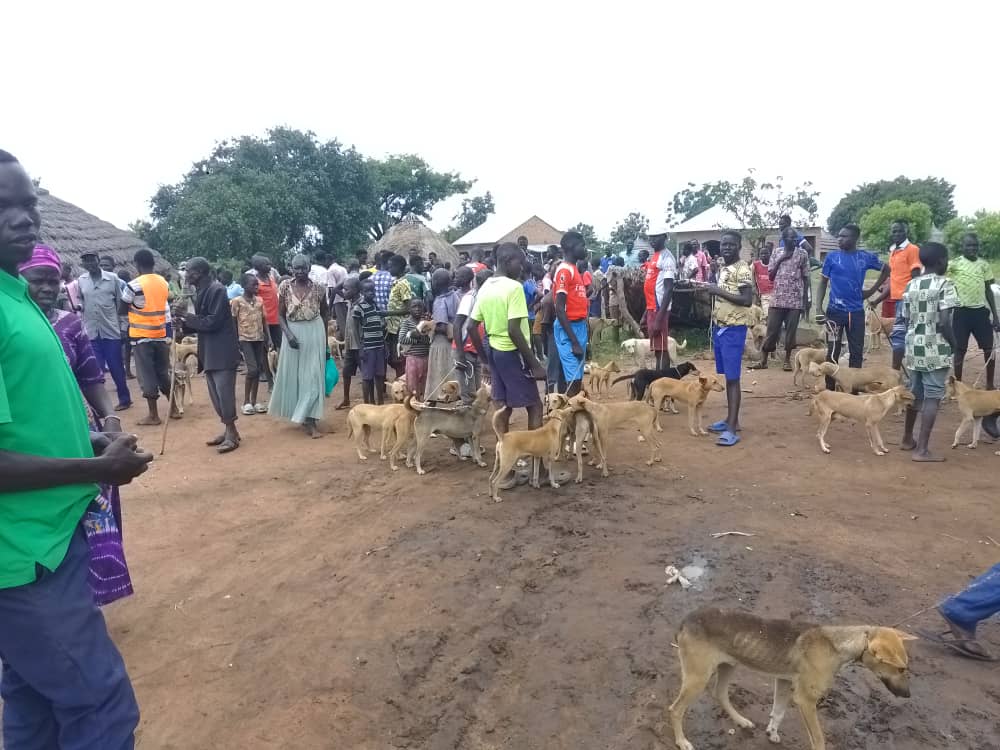
Dr. Anthony Odeke, the Acting District Veterinary Officer (DVO), revealed that the crackdown comes after the ongoing mass dog vaccination exercise, which kicked off on Monday, October 6, 2025.
The campaign has already seen a significant turnout, with more than 900 dogs vaccinated in just two days at Ngariam Akim BT Primary School.

“We have the register of each dog that has been vaccinated, along with the owner’s name. Any stray or unvaccinated dog found during the verification exercise will have no option but to be eliminated. The owner will equally be apprehended for interfering with the program,” Dr. Odeke warned.
He explained that the vaccination campaign targets at least 5,000 dogs across the rabies hotspot sub-counties of Ngariam, Palam, Omodoi, Okulonyo, Ongongonja, Guyaguya, Magoro, and parts of Getom and Akoboi.
The directive comes in the wake of a deadly rabies outbreak reported in Katakwi last week, in which two children lost their lives and at least 93 people were bitten by rabid dogs.
Health officials fear the situation could escalate if urgent measures are not taken to control the dog population and ensure mass vaccination.
Dr. Odeke emphasized that the rabies vaccine provides dogs with one year of immunity, after which booster doses must be administered.
He further urged residents to remain vigilant and to report any dogs exhibiting rabies symptoms such as unusual aggression, excessive drooling, abnormal barking, or indiscriminate biting of objects.
Local leaders in the affected sub-counties have thrown their weight behind the exercise, warning that residents who resist will face the full force of the law.
Moses Iteit, the LCIII chairperson of Ngariam Sub-county, confirmed that 14 people in his area alone have been bitten by suspected rabid dogs.
He said his administration had resolved to support the district’s plan to eliminate unvaccinated dogs and hold irresponsible owners accountable.
“The Sub-county authority has decided to launch a strict operation. Anyone who keeps dogs without vaccination will be apprehended. Those who sabotage the exercise must bear responsibility for leaving dangerous stray dogs in the community, especially since the government has supplied vaccines,” Iteit said.
The announcement has sparked mixed reactions from residents.
While some have welcomed the government’s tough stance, others fear losing their pets if they fail to access the vaccination points on time.
Zainabu Sebi, a member of Katakwi Town Council, praised the initiative but appealed to authorities to expand the vaccination program beyond hotspot sub-counties.
“Rabies is a deadly disease, and this program is very necessary. However, the government should extend vaccination services to the entire district to completely eliminate the threat,” Sebi suggested.
Other residents voiced concerns about the possibility of losing their dogs, which play a critical role in providing security for households in rural areas.
Rabies is a viral disease that attacks the central nervous system (CNS) of both humans and animals.
Once the virus reaches the brain, it multiplies rapidly, causing brain inflammation and almost certain death if untreated.
The disease is most commonly transmitted through bites from infected dogs, when saliva comes into contact with broken skin, eyes, the nose, or mouth.
According to the World Health Organization (WHO), rabies kills tens of thousands of people globally each year, with most cases occurring in Africa and Asia.
Uganda remains one of the countries battling recurrent rabies outbreaks, with Katakwi among the high-risk districts due to its large dog population and frequent cases of stray animals.
Dr. Odeke appealed to all residents to cooperate with veterinary officers and ensure their dogs are vaccinated during the ongoing campaign.
He reminded the community that prevention remains the only effective way of combating rabies, given its high fatality rate once symptoms appear.
“Rabies is 100 percent preventable through vaccination. This exercise is not about punishing dog owners but about protecting families, especially children, from needless deaths,” he said.
The Katakwi District Veterinary Department confirmed that follow-up operations will be conducted after the vaccination drive to identify unvaccinated animals.
Stray dogs will be eliminated immediately to curb the spread of the disease.
For advertising or to run your news article, contact us on 0785674642 or email tesonewsnetwork@gmail.com.
About Author